
AI, Data Centers, and Energy
As artificial intelligence spreads, hundreds of data centers are being proposed and built across the United States. These data centers are large, they use a lot of energy, and they are being built extremely quickly, ushering in a new era of rising energy demand which is reshaping our electricity grid. Without strong protective polices, powering these data centers could have devastating impacts on both air quality and household energy bills across the US.
What Are Data Centers?
Data centers are large buildings filled with computer servers, networking hardware, and cooling systems. These servers store and process information that makes online activities possible, including banking, social media, and video calls. Data centers have been around for decades, but the rapid expansion of generative AI since 2022 has increased the demand for new and larger data centers.
What is AI?
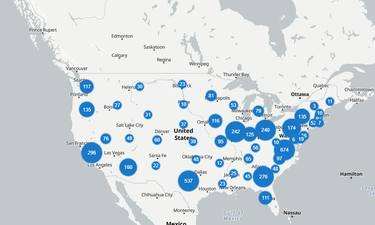
There are no federal registration requirements for data centers, so national estimates vary widely, especially at the current pace of development. Data Center Map, pictured above, estimates that there are over 4,000 data centers in the US, with many more proposed and under construction.
Artificial intelligence, or AI, is a technology that allows computers to do tasks that usually require human thinking, such as recognizing patterns, answering questions, or creating text and images. Generative AI refers to the ability to create new content – text, images, videos, audio, etc. Large language models (LLMs), such as OpenAI’s ChatGPT, are a type of generative AI. LLMs analyze large collections of text, images, and other data to learn patterns that can then be used to create new content.
How is AI Driving Data Center Growth?
LLMs require special high-speed computer servers with powerful computer chips that use more energy than traditional chips. Because of this, the tech companies behind LLMs—such as OpenAI, Microsoft, Google, or xAI—require data centers with massive, dense clusters of computer servers, known as hyperscale data centers. Competition among tech companies to produce the best LLM, as well as increased AI use and reliance on high-speed computing from other sectors, has led to the rapid expansion of data centers.
Why is Data Center Electricity Use a Concern?
◼ Data centers are getting bigger and using more electricity than ever. Data centers in the US consumed 183 terawatt-hours of electricity in 2024, which equals more than 4 percent of total US electricity use. A typical data center may use 10-25 megawatts (MW) of electricity when operating, which is already a lot of energy. However, some hyperscale data centers, such as the Homer City plant in Pennsylvania, can use gigawatts of electricity, as much as small cities. If this rate of energy growth continues, data centers could use up to 17 percent of total US electricity by 2030.
◼ Data centers are often built close together, which can strain regional power grids. Virginia currently hosts over 650 data centers, which account for 25 percent of the state’s energy use. The huge increase in regional energy use is outpacing available power generation, putting grid reliability at risk.
◼ Data centers are raising energy costs. To meet rising energy demand, utilities are building expensive new fossil fuel power plants, keeping older power plants running longer, and pursuing costly transmission system upgrades. Utility bills have gone up by more than $20 per month for the 67 million customers in the PJM Interconnection, the regional electric grid which includes Virginia, with an increase of $70 per month expected by 2028.
◼ Electricity demand from data centers is increasing pollution and derailing climate progress. To meet the fast pace of data center growth, grid operators are delaying the retirement of highly polluting power plants and running them more frequently, as well as fast-tracking the approval of new fossil fuel power plants. In some cases, such as xAI’s Colossus data center in Memphis, gas turbines are being allowed to run and pollute without a permit, despite outcry from the surrounding community. Researchers estimate that emissions from the US power sector could increase by 30 percent by 2030 because of electricity demand from data centers. One study of a data center in Virginia found that emissions from the site would lead to up to 33 premature deaths over the next five years, and up to $99 million per year in increased health costs.
What Can Be Done to Address These Impacts?
Policy tools can help reduce harmful impacts by slowing rushed development, requiring data centers to pay their fair share of electricity costs, improving transparency and community involvement, reducing electricity demand, and incentivizing the development of renewable energy and energy storage to meet rising demand. Communities facing proposed data center projects should ask how large the facility will be, how much electricity it will need, what power sources will be used, and who will pay for any necessary grid upgrades.
To learn more about data centers and energy, and to access resources for policymakers and community advocates, visit www.cleanegroup.org/data-centers.
AI, DATA CENTERS, AND ENERGY | AUGUST 2026 | WWW.CLEANEGROUP.ORG