

The ‘Guerrilla Solar’ Era Has Arrived, and Here’s What to Know
Plug-in solar provides the opportunity for more people to invest in the clean energy transition, experts say.
By Dan Gearino
June 25, 2026
Plug-in solar systems, often called “guerrilla solar,” are inexpensive and easy to install, making solar energy accessible to more people. While the financial savings are modest, ranging from $15 to $20 per month in the U.S., the systems empower consumers to participate in the clean energy transition and reduce reliance on the grid. Advocates emphasize the broader benefits, including land use efficiency and fostering a political consensus for renewable energy. (Read more from this article from Inside Climate News)
After Russia invaded Ukraine in 2022, electricity prices shot up across Europe and consumers looked for ways to save. One popular option was plug-in solar—inexpensive and easy-to-install renewable energy systems that began to appear in store aisles.
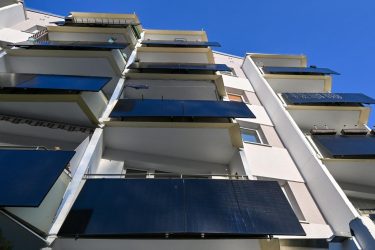
Plug-in solar panels sit on the balconies of a building in Erfurt, Germany. Credit: Martin Schutt/picture alliance via Getty Images
Now, Germany is the global leader in plug-in solar with about 1 million systems in official counts and probably many more that utilities and local governments haven’t counted.
I looked to Germany this week because I’ve been unsure whether plug-in solar makes sense for U.S. consumers, and I think Germany’s experience provides some clues about what may work here.
The benefits are clear. An entry-level plug-in system costs about $500 to $1,000 and can be installed in a backyard, on a balcony or on a roof. The electricity enters your home through a standard wall outlet, where it helps offset the electricity you draw from the grid. The low cost makes solar accessible for people who can’t afford to spend $10,000 or more on an electrician-installed rooftop array.
Here’s the main downside, as I see it: The financial benefits are small, starting at about $15 per month in the United States. It may make more sense financially to spend the cost of plug-in solar on insulation, air sealing or other basic measures to reduce energy use.
To help weigh the benefits against the concerns, I spoke with Craig Morris, the CEO of Bundesverband Steckersolar, Germany’s plug-in solar trade association. Readers may recognize that name. He is a U.S. native who has spent his adult life working as a clean energy advocate and researcher in Germany, and he was a key interview subject in my 2020 series about Germany’s energy transition, and another story since then.
“The distinctive thing about this technology is it’s so small that you don’t need an electrician to plug it in,” he said in a video interview from Berlin.
Craig Morris is the CEO of Bundesverband Steckersolar, Germany’s plug-in solar trade association. Credit: Dan Gearino/Inside Climate News
The do-it-yourself nature of the product is one reason it’s sometimes called “guerrilla solar,” with people installing it even in buildings and jurisdictions where it’s not allowed.
Morris previously worked for a nonprofit that advised the plug-in solar association. As plug-in solar grew in popularity, the association needed its first full-time manager and hired Morris last year.
He and his members are now working to convince the European Union to adopt rules that would allow plug-in solar across the bloc, rather than the patchwork now in place. Germany and Belgium passed plug-in solar laws in 2024 and other nations have followed suit. Hungary and Sweden are among the countries with restrictions.
I asked him if savings from plug-in solar may be too small to be worthwhile.
He responded by referring to an analysis his organization published this week that serves as a useful primer. It has a page comparing costs and payback periods in six international cities for a system that costs about $570.
The fastest payoff is 4.26 years in Berlin, largely because the region has high electricity prices, which create more opportunity for savings by generating your own power.
The slowest payoff is 9.56 years in Ho Chi Minh City, Vietnam, where electricity prices are unusually low.
Kansas City, Missouri, the only U.S. city listed, has the fourth-fastest payoff with 4.99 years. The city has high household electricity consumption, which means electricity generated by the panels is almost entirely consumed onsite, accelerating the payback period. This factor is offset by the region’s electricity rates, which are lower than those in all but Ho Chi Minh City.
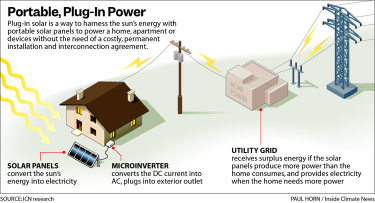
Utilities tend to be the primary opponents of plug-in solar, citing safety concerns. I’m not going to go point by point through the objections, other than to say that consumers shouldn’t plug a solar panel into a broken outlet or one that’s on a circuit that’s already prone to overloading.
To get a view from closer to home, I contacted Steven Hegedus, an engineering professor at the University of Delaware who has spent most of his career researching solar power.
Like Morris, Hegedus is someone I’ve known for a while, a longtime friend of my wife’s family. He’s also an expert in plug-in solar who appeared last year on the radio program Living on Earth.
Hegedus’ main concern is that the often-touted plug-in solar savings numbers may be overstated. He has kept an informal tally of costs and savings for systems in his region and has found that some would take 10 to 15 years to pay off.
He thinks payoff estimates are usually based on systems in markets with expensive electricity, such as California, which doesn’t apply to most of the country.
And he believes the savings estimates are based on systems that have been installed in positions that maximize sunlight exposure. But with the product’s do-it-yourself process, he argues that not all customers install it in the most effective location.
He thinks the benefits of plug-in solar probably exceed any concerns. The main benefit is that plug-in solar is widely accessible, creating an opportunity for many more people to generate clean energy, assume greater responsibility for their energy use and feel connected to the energy transition.
“You’re doing this for reasons other than just to save money,” he said.
The legal status of plug-in solar is unclear in much of the country. Bright Saver, a plug-in solar advocacy group, counts nine states that have passed laws or rules allowing the systems: Colorado, Connecticut, Maine, Maryland, New Hampshire, New York, Utah, Vermont and Virginia. Four states have bills that have passed one legislative chamber: California, Massachusetts, Minnesota and New Jersey.
California is almost certainly the leader in plug-in solar purchases, according to industry professionals, but I haven’t found any reliable data. The estimates I’ve heard are thousands of systems, so we’re talking about an industry that’s just getting started.
For more information, Solar United Neighbors, EnergySage and Bright Saveroffer resources to help consumers answer basic questions about costs, savings and technical issues.
A few years ago, it would have been easy to dismiss a comparison of Germany and the United States as plug-in solar markets since electricity is much more expensive in Germany. But U.S. power bills have soared in recent years and are likely to continue doing so.
As this happens, plug-in solar will become a better deal, and, I think, much more popular.